Showing posts with label Other utensils. Show all posts

Friday, June 20, 2014

Fire engine

The station-master had not finished his speech before we were all hastening in the direction of the fire. The road topped a low hill, and there was a great widespread whitewashed building in front of us, spouting fire at every chink and window, while in the garden in front three fire-engines were vainly striving to keep the flames under.
(Adventure IX, pg. 130)

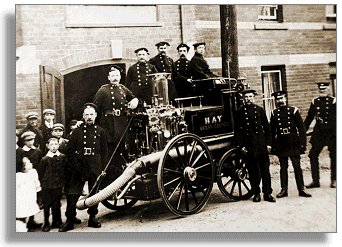
Steam fire pump, 1901
Horse pulled steam powered fire pump from the early 1900.

Links:

Hydraulic stamping machine / Hydraulic press

"'I say a night's work, but an hour's would be nearer the mark. I simply want your opinion about a hydraulic stamping machine which has got out of gear. If you show us what is wrong we shall soon set it right ourselves. What do you think of such a commission as that?'
(Adventure IX, pg. 122)

This we have now been doing for some time, and in order to help us in our operations we erected a hydraulic press.
(Adventure IX, pg. 123)


Crystal Palace
A huge hydraulic press designed by Stevenson that had lifted the metal tubes of a bridge at Bangor, was one of the exhibits in the Great Exhibition of 1851 in the Chrystal palace.

Links:

Wax vestas (matches)

He is a professional beggar, though in order to avoid the police regulations he pretends to a small trade in wax vestas.
(Adventure VI, pg. 77)

In 1832, William Newton patented the "wax vesta" in England. It consisted of a wax stem that embedded cotton threads and had a tip of phosphorus. Variants known as "candle matches" were made by Savaresse and Merckel in 1836.

Links:

Thursday, June 19, 2014

Watch

In the latter, as may be remembered, Sherlock Holmes was able, by winding up the dead man's watch, to prove that it had been wound up two hours before, and that therefore the deceased had gone to bed within that time--a deduction which was of the greatest importance in clearing up the case.
(Adventure V, pg 60)

The pocket watch was a common accessory in the 1900s.

Links:

Wednesday, June 18, 2014

Typewriter

"Do you not find," he said, "that with your short sight it is a little trying to do so much typewriting?"
(Adventure III, pg. 35)


Links:
- Image source
- Description and history

Handcuffs

"I beg that you will not touch me with your filthy hands," remarked our prisoner as the handcuffs clattered upon his wrists. "You may not be aware that I have royal blood in my veins. Have the goodness, also, when you address me always to say 'sir' and 'please.'"
(Adventure II, pg. 32)


Links:
- Image source
- History of handcuffs

Magnifying lens

Merryweather perched himself upon a crate, with a very injured expression upon his face, while Holmes fell upon his knees upon the floor and, with the lantern and a magnifying lens, began to examine [...]
(Adventure II, pg. 30)

all original antique english sterling silver magnifying glass 1900

Links:
- Image source
- Description and History

Hunting Crop

"Ha! Our party is complete," said Holmes, buttoning up his pea-jacket and taking his heavy hunting crop from the rack.
(Andventure II, pg 29)


Links

Camera

"Oh, he has his faults, too," said Mr. Wilson. "Never was such a fellow for photography. Snapping away with a camera when he ought ot be imporving his mind, [...]
(Adventure II, pg 21)


Links:

Thursday, May 29, 2014

Photograph

"You see," remarked Holmes, as we paced to and fro in front of the house, "this marriage rather simplifies matters. The photograph becomes a double-edged weapon now. The chances are that she would be as averse to its being seen by Mr. Godfrey Norton, as our client is to its coming to the eyes of his princess. Now the question is, Where are we to find the photograph?"
(Aventure I, A SCANDAL IN BOHEMIA pg. 13)

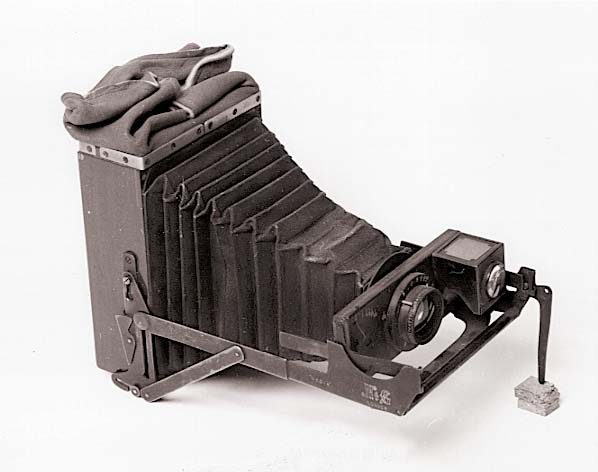
Bellows Camera - 1850s

The first permanent photograph was developed by Thomas Wedgwood in 1790, however, it wasn't until 1822 that an actually clear photograph was made by a French inventor, Joseph Nicéphore Niépce. Thanks to the evolution of chemstry, the process of photo development evolved throughout the 19th century. In the Victorian Era, many chemical process were invented in order to reveal those photographs, examples of which are the collodium process, gelatin process and lifochrome process.
Wednesday, May 28, 2014

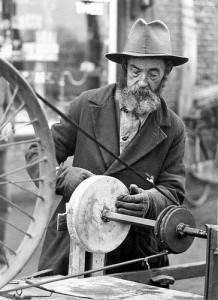
Scissors-grinder

"There was a group of shabbily dressed men smoking and laughing in a corner, a scissors-grinder with his wheel, [...]"
(Aventure I, A SCANDAL IN BOHEMIA pg. 13)


In the Victorian London it was common to see scissors and knife grinders riding their carts along the streets. The grinding mechanism was fairly simple, it consisted of a pedal moved grinding wheel mounted on a cart. In later models the grinder wheel would be mounted on bicycles in stead of a cart.

Links:
Image Source
Historical references